
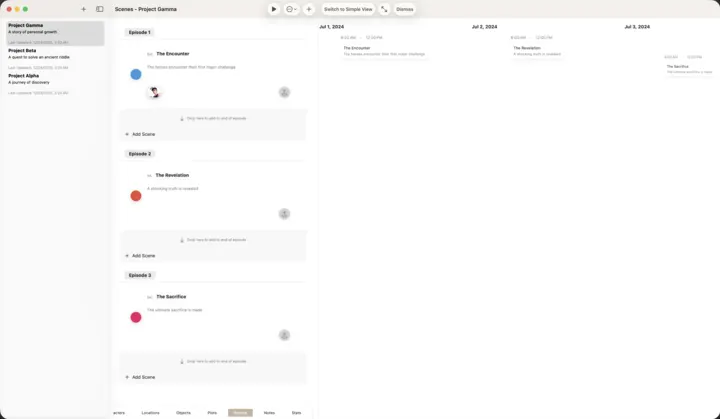
A scene does not need to be long to be useful. It needs an intention, resistance and a result that changes what can happen next.
Use the scene spine
- Point of view
- Whose experience organizes the scene and filters what the reader can know?
- Goal
- What does that character want to achieve now?
- Conflict
- What blocks the goal or makes the cost of success higher?
- Outcome
- What changes: success, failure, compromise, revelation or a new problem?
Create and connect the scene
- Open Scenes in the project and choose New Scene.
- Place the scene in a section or leave it unassigned while you explore.
- Choose the point-of-view character, type and story beat when known.
- Add the location and participants so later timeline and relationship views have context.
- Write the goal, conflict and outcome in plain language.
- Add main plot, dates, tension and tags only when they improve a later decision.
Chronological time and narrative order
Use beginning and ending dates for what happens in the story world. Keep the scene position for the order in which the reader encounters it. When those orders diverge, record the reason in a note or plot beat so the difference stays intentional.
When a scene feels flat
- Give the point-of-view character a concrete choice.
- Make the conflict oppose the goal instead of simply adding atmosphere.
- Change information, relationship, position or commitment by the outcome.
- Split a scene when it contains two separate decisions with no causal link.